


Tyrereviews All-season tire test 205/55 R16 2024
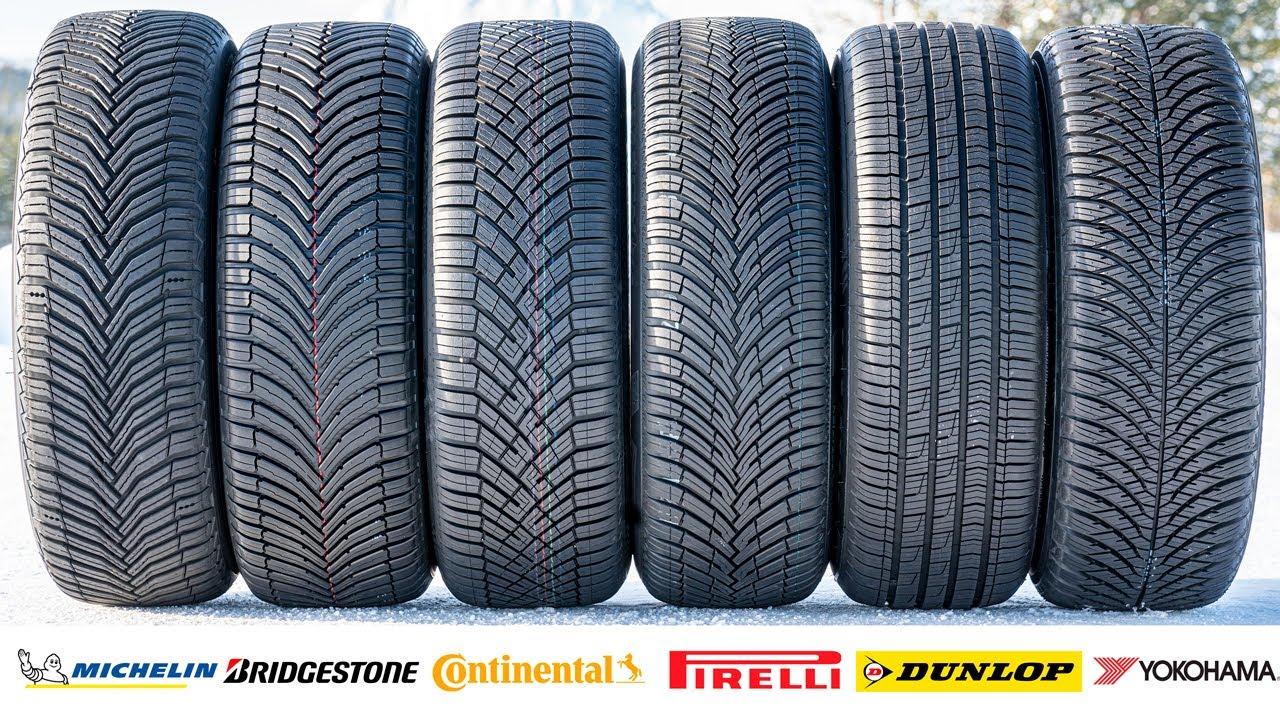
The Michelin CrossClimate 2 has been the best all-season tire on the market for years, but it's now being challenged by new premium models from Bridgestone , Continental , and Pirelli . I also compared Dunlop and Yokohama in the test to see if any of these tires can dethrone Michelin.

Top 3 from the test
You'll find the complete ranking in the "All tyres" tab below.

 Bridgestone
 Turanza All Season 6
 C
C B
B B (70 dB)
 Test winner
 Continental
 AllSeasonContact 2
CBB (70 dB)
 Pirelli
 Cinturato All Season SF3
CAB (72 dB)Build a comparison from this test
Select tyres and metrics — the visualisation redraws instantly.
Top 3 by default. For a clear comparison, max. 5 tyres.
Each metric has its own visualisation. Click a chip to add/remove.
 Braking distance in the wet m · ↓ lower is better
  Braking distance in the dry m · ↓ lower is better
  Noise dB · ↓ lower is better
  Estimated mileage km · ↑ higher is better
 Informácie o teste
Best All-Season Tires 2024: Can Anyone Dethrone the Michelin CrossClimate 2?
For years, the Michelin CrossClimate 2 has been considered the best all-season tire on the market, winning more tests than any other model—including my last three years of testing. But this year, three new premium all-season tires from Bridgestone, Continental, and Pirelli are vying for the title of best all-season tire of 2024.
In my big test of all-season tires, I looked at everything from wet and dry performance to wear and tear. I also included models from Dunlop and Yokohama in the comparison to make the test as comprehensive as possible.
Which brand will ultimately offer the best all-season tires for 2024? Will the Michelin CrossClimate 2 remain at the top, or will the new products finally overtake it?
Tire performance on wet roads (Wet Performance)
We say it every year – the performance of an all-season tire on wet roads is the most important parameter.

As always, I included a budget tire in the test, and this time it was exceptionally bad. I don't remember having to concentrate so hard to keep the car on the track at all - and that was only with a VW Golf 1.4. It would have been completely impossible on the back. However, the other tires performed quite well in terms of wet handling. The Yokohama and Michelin were among the slowest, both showing a noticeable understeer character, while the Yokohama also had a very soft steering feel - but they still managed to drive safely.
Bridgestone and Dunlop fared slightly better. Interestingly, Bridgestone not only looked similar to Michelin, but also behaved similarly – it had great grip, but more understeer than its best rivals. It wasn’t the best balance on the track, but it felt safe on the road. Dunlop, as the only asymmetric tire in the group with the Sport designation in its name, didn’t feel like a particularly sporty model, but it was pleasant to drive and predictable.
The new Pirelli and Continental tires ultimately shared the lead. The Pirelli felt the sportiest, with precise steering and neutral balance, but didn’t have as much detailed feedback at the limit as the Continental. The Continental was excellently balanced throughout the lap – perhaps a little less nimble in steering, but with better response at the limit of grip.
In wet braking, the Bridgestone performed excellently, stopping almost a meter before the second-place Continental and more than a meter before the third-place Pirelli. A result that deserves respect. The cheap tire was again disastrous – by the time the Bridgestone had completely stopped, it was still at 45.1 km/h, braking from 80 km/h !
The tires had no significant problems with aquaplaning during the test, but Pirelli performed best, followed by Bridgestone and Michelin.
Dry Performance

Since these are 16" all-season tires, pure dry lap time is not the most important factor – dry braking is much more important. Nevertheless, I spent a lot of time testing steering response and sharp lane changes to see how the tires behave in real-world situations. And of course, there was also a dry track handling test, which is always fun.
The slowest tire per lap was the Fronway. It performed quite well during sharp lane changes and was even more direct than some of the competitors, but on the track it exhibited significant and noisy understeer. The rest of the tires had very balanced results. The Yokohama and Michelin were slightly more understeer, but the Michelin demonstrated one of the best steering responses just below the grip limit.
The Bridgestone felt slightly inaccurate around the steering wheel's center position, which I didn't like, but it was quick, sporty, and responsive when cornering - the result was a very good wheel and solid brakes.
The Continental and Dunlop had almost the same times. The Dunlop, with its asymmetric tread pattern, responded very quickly, but the tire took a short time to settle on the sidewall. The Continental was a joy to drive - one of the few tires where I felt in full control of the vehicle, whether steering or using the throttle. Great wheel and excellent handling under the limit.
The Pirelli was the best, however – not only was it the most stable in the lane change test, but it also offered the best handling and felt the closest to a summer tire. That’s exactly what I expect from a top-of-the-line all-season tire. So the new Pirelli SF3 is showing itself in a very good light, but Continental, Dunlop and Bridgestone also did an excellent job.
In the dry braking test, Pirelli proved to be the best, stopping more than a metre ahead of the second-placed Bridgestone. The traditional dry braking leader, Michelin, came in third, well ahead of the last four tyres. As in the wet test, the residual speed showed huge differences – the worst tyre in the group was still almost 40 km/h at the speed where the Pirelli was already standing.
Snow Performance
The good news is that all the all-season tires performed well in the snow – except for the Dunlop.

It wasn't exactly bad, but as the only tire without a directional tread pattern it showed why most manufacturers are switching to directional patterns. In the snow, asymmetric tires simply lose. The Dunlop was the slowest on the bike and even the stable Golf had a more unstable rear with it. Fun for those who want a challenge, but not the best balance on the road.
Next up was the Bridgestone, which felt very comfortable on snow, but the steering was extremely light. The balance was good and the rear stable, but it lacked the grip of the best. The Bridgestone's great advantage in wet braking turned out to be a weakness here - snow grip was lagging behind. The Yokohama was a step better, which didn't feel dramatic, but was excellent in traction and braking in snow.
Objective tests (traction, braking, snow circuit) confirmed this: Continental and Yokohama were the best in traction, Michelin and Yokohama dominated in snow braking, and Michelin was the clear winner in the snow circuit.
Surprisingly, the new Continental and the cheap Fronway shared fourth and third place. The times were almost identical, but the Continental was more predictable and better at coming out of corners. However, the difference was clear – the Continental handled both dry and wet, while the Fronway was a disaster outside of snow. This is exactly what separates a cheap tire that can do one thing from a premium tire that can do everything.
Second place went to the new Pirelli, which – just like in the dry and wet – was a lot of fun to drive. It felt best in cornering while offering strong traction and braking. It was the second fastest on the bike and almost my favorite in the snow.
The winner, however, was once again the Michelin CrossClimate 2, which performed fantastically in the snow. Halfway through the test lap, I suspected it was the Michelin – it was so convincing. Powerful braking, excellent traction when crossing, secure balance – it simply did it all. Although some new products have managed to overtake it in the dry and wet, in the snow the Michelin CrossClimate 2 remains the king of winter performance .
Tyrereviews All-season tire test 205/55 R16 2024
7 products · click a column to sort| # | Tyre | Price from | Dry braking [m] ↕ | Dry manoeuvring [s] ↕ | Wet braking [m] ↕ | Aquaplaning straight [km/h] ↕ | Aquaplaning cornering [m/s²] ↕ | Snow braking [m] ↕ | Snow manoeuvring [s] ↕ | Snow traction [s] ↕ | Ice braking [m] ↕ | Ice traction [s] ↕ | Volume [dB] ↕ |
|---|---|---|---|---|---|---|---|---|---|---|---|---|---|
| 1. | Continental AllSeasonContact 2 ✓ Available in size 205/55 R16 | from 88 € | 41.1 | 55.8 | 34.1 | 78.5 | 2.92 | 18 | 92.18 | 8.04 | 6.67 | 4.78 | 71 |
| 2. | Bridgestone Turanza All Season 6 ✓ Available in size 205/55 R16 | from 84 € | 38.9 | 56 | 33.2 | 81.3 | 3.12 | 18.2 | 95.01 | 8.57 | 7.11 | 4.88 | 71.6 |
| 3. | Pirelli Cinturato All Season SF3 ✓ Available in size 205/55 R16 | from 88 € | 37.7 | 55.4 | 35.5 | 84.2 | 3.43 | 18.8 | 91.99 | 8.46 | 6.89 | 4.68 | 71.7 |
| 4. | Michelin CrossClimate 2 ✓ Available in size 205/55 R16 | from 92 € | 39.2 | 56.4 | 37.3 | 80.1 | 3.22 | 17.6 | 90.68 | 8.69 | 6.79 | 4.97 | 70.9 |
| 5. | Dunlop Sport All Season ✓ Available in size 205/55 R16 | from 107 € | 43 | 55.8 | 36.8 | 76.4 | 2.99 | 18 | 95.45 | 8.46 | 7.47 | 5.56 | 72 |
| 6. | Yokohama BluEarth 4S AW21 ✓ Available in size 205/55 R16 | from 71 € | 44.3 | 56.6 | 38 | 75.5 | 2.7 | 17.6 | 93.51 | 8.04 | 6.48 | 5.44 | 73.5 |
| 7. | Fronway Fronwing AS ✕ Unavailable in size 205/55 R16 | — | 43.6 | 58.1 | 48.7 | 70.2 | 2.14 | 17.9 | 92.16 | 9.11 | 6.79 | 4.94 | 71.1 |
Dry braking [m]

Dry manoeuvring [s]

Wet braking [m]
Aquaplaning straight [km/h]

Aquaplaning cornering [m/s²]
Snow braking [m]
Snow manoeuvring [s]
Snow traction [s]

Ice braking [m]
Ice traction [s]
Volume [dB]

The Michelin CrossClimate 2 has been the best all-season tire on the market for years, but it's now being challenged by new premium models from Bridgestone , Continental , and Pirelli . I also compared Dunlop and Yokohama in the test to see if any of these tires can dethrone Michelin.